

—— Knowledge Base ——
Best Practice Voice Of Customer Research
Everybody knows that their product development process should start with the “voice of customer.” However, there’s wide variety of interpretation of what this means and how to approach it. Here we outline the TCGen viewpoint on what constitutes best practice, with emphasis on teams developing products with hardware components in existing markets. (Pure software products and startups will leverage the same principles, though have some additional techniques available to achieve them.)
High-Level Criteria of “Best Practice”
A best practice process will exhibit each of the following:
- Qualitative research. This consists of first-party customer research and includes verbatims or concise anecdotes that illustrate pain points of the status quo among representatives from each of the ideal customer profile personas.
- Quantitative data. Evidence to demonstrates that qualitative data above can reasonably be interpreted to be representative of the broader personas.
- Hypotheses to be tested. These should articulate some delighters that could be validated or refuted during concept testing in later phases of the NPD process.
- Price sensitivity analysis. An initial indication that customers are willing to pay for the hypothesized solutions (in #3) to the articulated pain points (in #1).
Note that it also must fit within a broader context. For the purposes of this document we are assuming that a Best Practice Voice of Customer document fits within a broader context that includes:
- A GTM Framework for the company that provides clear accountabilities, an empowered core team, high-level process phases milestones, and executive sponsorship, oversight, and escalation / resolution procedures.
- Other Design-Phase deliverables in the GTM Framework, which include written definitions of customer personas, value chain mapping, market sizing, and analysis of competitive alternatives.
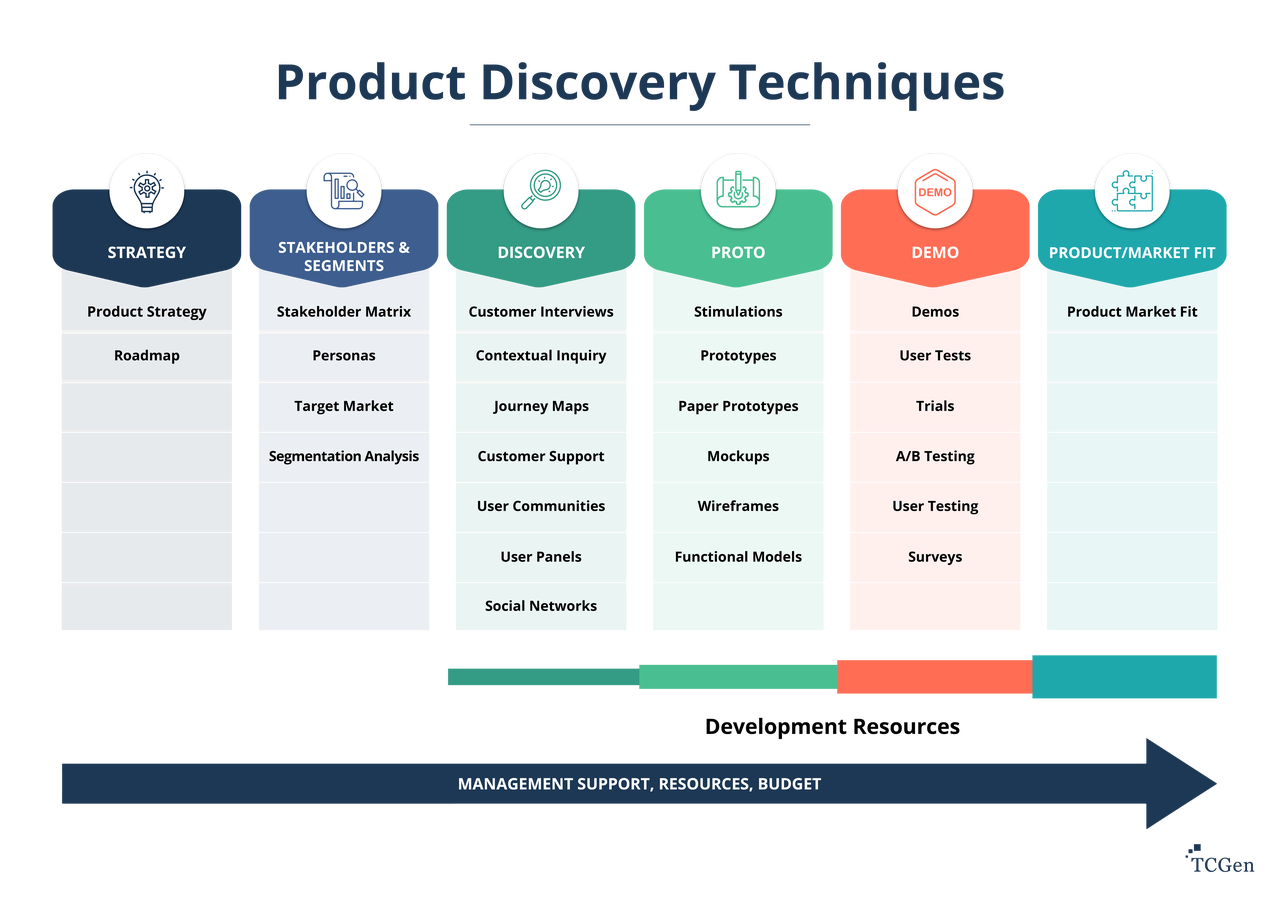
Product Discovery Techniques
The qualitative and quantitative evidence above can collectively be viewed as product discovery, and are based in understanding customer empathy. Typically this is done through a series of steps, performed by the core team (led by product management or product marketing). Usually this is deployed for major platform releases or new-to-company product categories. Customers include users, buyers, influencers, and distribution/dealers. This process typically takes 6 - 12 weeks depending on geographic scope and customer access.
The first step is to segment customers, then understand their purchasing journey, then perform cross functional customer visits using a consistent, open ended-interview guides. This work is aggregated across the customer visits and the core team prioritizes need statements - boiling down a hundred or more ‘voices’ to the top ~20 or so.
- Contextual Inquiry is a great way to get qualitative insights. By being on-site with a customer, researchers gain insights to how their product may be used and, importantly, what else is going on for the customer at the time. Any new product delivers value only in conjunction with the situation in which it is deployed, and contextual inquiry provides invaluable insight to the myriad situations in which a new one will be leveraged.
- If this is a new market, or there are segment differences, a quantitative survey is performed with the sample population (or larger). A Kano survey helps the team determine if the requirement is a “must-have”, “more-is-better”, or “unexpected” or a “delighter.”
Hypothesized Solutions
Articulating hypothesized solutions that are testable in later phases is crucial for several reasons. First, it provides a clear direction for product development, ensuring that the team has concrete ideas to validate or refute. This approach helps to bridge the gap between customer needs and potential product features, making the development process more focused and efficient. Moreover, having testable solutions allows for iterative refinement, enabling teams to adjust their concepts based on real feedback and data.
Equally important is gathering evidence that customers are willing to pay for these hypothesized solutions. This step is vital for assessing the commercial viability of the product concept. It helps in avoiding the pitfall of developing features that, while interesting, may not translate into actual purchases. By validating price sensitivity early in the process, teams can make more informed decisions about resource allocation and product positioning.
Two effective techniques for approaching these aspects are:
- Concept Testing: Create simple prototypes or mockups of the hypothesized solutions and present them to a sample of the target audience. This can be done through focus groups or one-on-one interviews. Gauge their reactions, gather feedback, and ask about their willingness to pay for such solutions.
- Van Westendorp’s Price Sensitivity Meter: This method involves asking customers a series of questions about price points to determine an acceptable price range for the proposed solution. It helps in understanding the perceived value of the product and identifying the optimal price point.
By incorporating these techniques, teams can validate their hypotheses and gain valuable insights into pricing strategy, ensuring that the product development process is grounded in both customer needs and market realities.
Conclusion
Best practice Voice of Customer (VoC) research is a critical foundation for successful product development. It combines qualitative and quantitative approaches to gain deep customer insights, formulate testable hypotheses, and assess price sensitivity. This comprehensive approach ensures that product development is firmly rooted in customer needs and market realities.
By following these best practices, companies can:
- Develop products that truly resonate with their target audience
- Minimize the risk of investing in features that customers don’t value
- Create a solid foundation for pricing strategies
- Foster innovation by identifying unexpected delighters
Ultimately, a well-executed VoC process sets the stage for product success by aligning development efforts with customer expectations and market demands. It’s an investment that pays dividends throughout the entire product lifecycle, from conception to launch and beyond.