


—— Knowledge Base ——
Best Practice Boundary Conditions and Escalation Process
A best practice process for establishing boundary conditions and constructive escalation helps empower a core team to be productive, engages executive sponsorship and keeps them well-informed, and resolves disagreements quickly and productively.
- Establish boundary conditions that are refined at each phase of development
- Provides guidelines for how and when to escalate
This is a critical piece of a best practice GTM Framework, and works in conjunction with other important aspects of the framework.
Establishing Boundary Conditions
Creating effective boundary conditions involves defining clear parameters for a project team’s decision-making autonomy. These conditions typically cover areas such as schedule, budget, product features, and quality metrics. They are established collaboratively by the team and executives, ensuring alignment with company goals. Boundary conditions should be specific, measurable, and adjustable as the project progresses. When a team anticipates exceeding these pre-set limits, they must escalate to leadership, promoting a “manage by exception” approach. This process empowers teams to work independently within agreed-upon constraints while providing a structured method for seeking guidance when needed, ultimately enhancing efficiency and communication in project management.
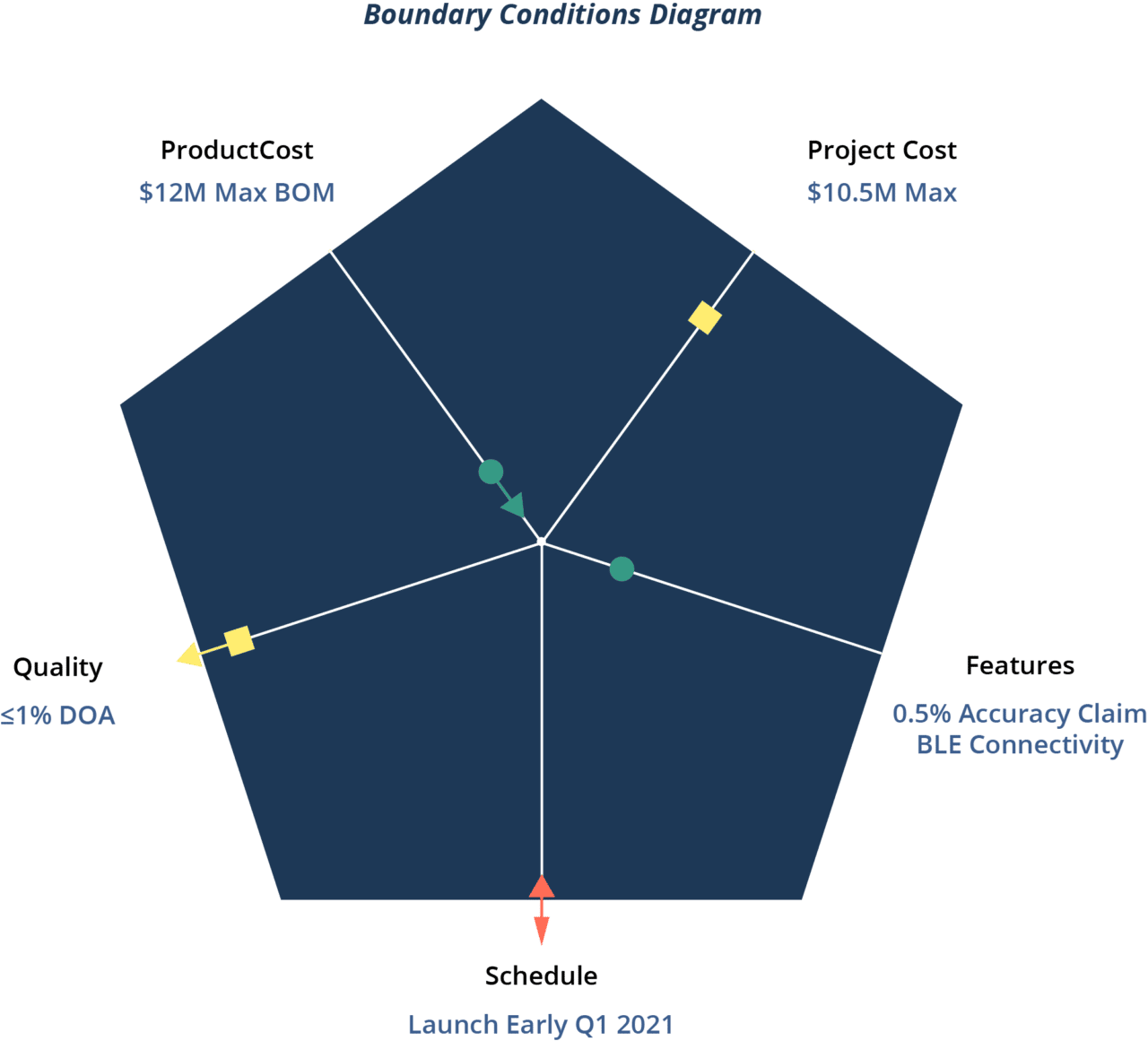
Best practice boundary parameters
| Parameter | Description |
|---|---|
| Schedule milestones and deadlines | Project completion date, phase gate reviews |
| Budget constraints and financial targets | Maximum project spend, ROI expectations |
| Key product features and specifications | Must-have functionalities, performance requirements |
| Quality metrics and performance standards | Defect rates, customer satisfaction scores |
| Resource allocation limits | Maximum team size, equipment availability |
| Risk tolerance levels | Acceptable market uncertainties, technical challenges |
Refinement over time
These boundary conditions become increasingly refined during the New Product Development (NPD) process:
- Initial Phase: Broad parameters are set based on high-level business objectives and market analysis.
- Concept Development: Conditions are refined to reflect more specific product requirements and target market needs.
- Detailed Design: Boundaries become more precise, incorporating technical specifications and production constraints.
- Testing and Validation: Conditions are adjusted based on prototype performance and user feedback.
- Launch Preparation: Final refinements are made to align with production capabilities and go-to-market strategies.
This progressive refinement allows for flexibility while maintaining control, enabling teams to adapt to new information and challenges as they arise throughout the development process. It also facilitates the “manage by exception” approach, where teams can operate autonomously within these evolving boundaries, escalating issues only when conditions are at risk of being exceeded.
Constructive Escalation Process
“Escalation” often feels like a threat, but with a constructive escalation process it need not feel this way. Building great products means bringing into balance many forces that sometimes pull in different directions.
- Singular decision-maker. (A committee of 3 is an acceptable substitute.)
- Clear instructions on how to initiate an escalation, and what to deliver to the decision-maker
- Response protocol with fast turnaround, clear guidance, and documented rationales
Decision-maker
A singular decision-maker or a small committee of three brings immense value to the escalation process by providing clear accountability and swift resolution. This approach ensures that decisions are made efficiently, avoiding the pitfalls of decision-by-consensus that can lead to delays and diluted outcomes. The ideal decision-maker, often the COO or a committee comprising key leaders from product, marketing, and operations, should possess a holistic view of the company’s interests, strong peer relationships, and the ability to make tough calls when necessary. Their role is crucial in maintaining project momentum and alignment with strategic goals.
Escalation and response process
A constructive escalation process serves as a vital safety net for project teams, allowing them to navigate disagreements and seek guidance when needed. The process typically begins with the core team attempting to resolve differences within established boundary conditions. If resolution isn’t possible, the team initiates the escalation by preparing a concise summary of the issue, including key facts, differing viewpoints, and potential impacts. This summary is then submitted to the designated decision-maker or escalation committee.
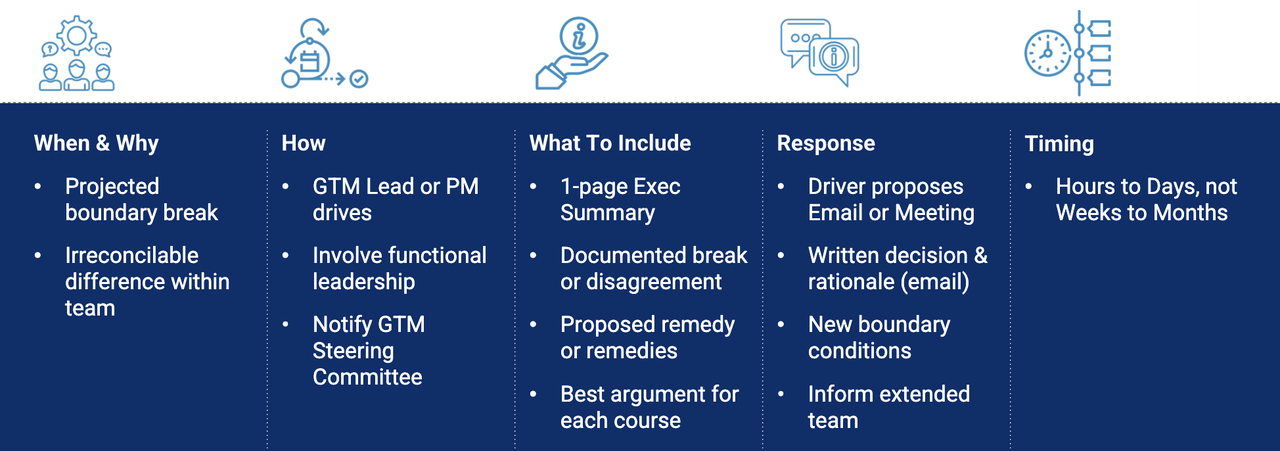
Upon receiving the escalation, the decision-maker reviews the information promptly, often within 24-48 hours. They may request additional clarification if necessary. The decision-maker then provides clear guidance, including the rationale behind their decision and any adjustments to boundary conditions. This response is communicated back to the team, allowing them to quickly implement the decision and move forward.
The entire process, from escalation to resolution, is designed to be swift and efficient, typically completed within a week. This approach ensures that disagreements are addressed productively, maintaining project momentum while providing teams with the support and direction they need to navigate complex challenges.
Further Reading
- Escalation Process in 4 Steps: See reference in link
- Boundary Conditions Presentation with Process Steps: See presentation in link
- Boundary Conditions: Getting a Project Back on Track: See reference in link
- Example of Boundary Conditions (for product development): See example in link
- Boundary Condition & Escalation TOOLS: See downloadable tools in (High Performance Teams section, towards the bottom of the list of tools)