
—— Case Study ——
Agile Transformation for a Fabless Semiconductor Startup
What Claros Said About the Engagement
“Since working with TCGen our teams are moving faster, with more clarity and less friction. It was a practical, thoughtful, and tailored system to our needs. And it felt like a true partnership.”
— Mike Herndon, VP of Engineering, Claros
Why Standard Agile Doesn’t Work for Semiconductor Development

Claros is a fabless semiconductor startup based in Los Angeles developing innovative power management ICs. Like most companies designing chips, their development process was governed by a hard constraint that software companies don’t face: the tapeout.
A tapeout is the final step in IC design before a chip goes to the fab for manufacturing. It’s expensive, long-lead, and irreversible. Unlike a software release that can be patched overnight, a design sent to fabrication locks in every decision made upstream. That reality makes standard agile methodology hard to apply out of the box—you can’t iterate on a chip like you can on a mobile app.
The result at Claros was a familiar pattern in early-stage hardware companies: coordination happened ad hoc, cross-functional awareness was limited, and design escapes—defects that slipped through to tapeout—were a recurring problem. The team was talented and motivated, but lacked the structure to connect daily engineering work to the bigger milestones that mattered: tapeout dates and Go-To-Market commitments.
Chip Design Challenges: Design Escapes and Coordination Gaps
Claros needed a better way to work—but not a wholesale agile transformation that would conflict with chip design reality. The specific pain points were:
- Design escapes slipping through to tapeout, creating costly rework after fabrication
- Limited cross-functional visibility between IC design, verification, firmware, and product teams
- No systematic link between daily engineering work and tapeout or GTM milestones
- Reactive coordination via ad hoc meetings rather than a predictable cadence
- No shared definition of done at either the story or sprint level
Our Approach: Agile That Respects the Physics
Standard agile frameworks were designed for software—where deploying to production is fast and cheap. Chip design has different physics: tapeouts are rare, expensive, and irreversible. Rather than force a software agile model onto hardware development, TCGen’s agile consulting practice designed a framework from first principles that works with the tapeout cycle, not against it.
The guiding principle: “Always one sprint away from tape-out.” Rather than trying to tape out every sprint—which is impractical—the team aspires to a state of readiness where completing one more sprint would leave them tape-out ready. This shift in mindset drives continuous integration, verification, and documentation, rather than letting them accumulate before a deadline.
1. Aligning Sprints to Tapeouts and GTM Goals
The first step was designing the macro-level framework: a visual map connecting Go-To-Market milestones, tapeout dates, and bi-weekly sprints into a single coherent picture.
This gave every person in the company—engineer, PM, or executive—a shared orientation to “where we are.” Instead of planning work in isolation, each sprint could be understood in the context of which tapeout it was building toward and what customer milestones that tapeout would serve.
2. Establishing a Bi-Weekly Sprint Cadence
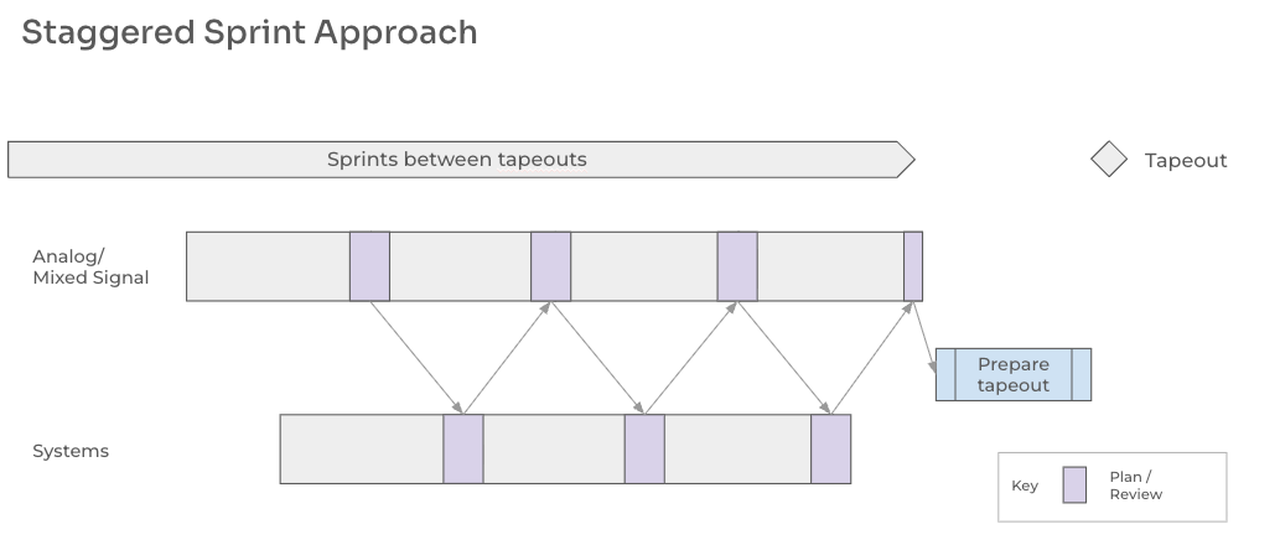
TCGen established a staggered bi-weekly sprint cadence that fit within the natural rhythm of the design cycle. The cadence replaced informal, reactive communication with structured sprint rituals—replacing ad hoc status updates with a predictable rhythm of planning, execution, demo, and retrospective.
3. Defining Done
One of the most impactful interventions was creating clear definitions of “done” at two levels:
- Sprint-level: A “Sprint Quality Checklist” served as the team’s shared definition of a successful sprint—covering commitments to review, documentation, and quality standards that needed to be met before a sprint could close.
- Story-level: A “Minimal Viable Done” checklist defined criteria for considering a single story complete, encouraging smaller, better-scoped stories that could fully close within a single sprint.
This gave the team a common standard for evaluating progress and reduced the ambiguity that had previously led to design escapes and incomplete handoffs between disciplines.
4. Building Transparency Through Kanban and Metrics
To make progress visible, TCGen introduced a simple Kanban board tracking stories from “sprint-ready” through to “complete.” The board was deliberately simple at the outset—emphasizing adoption and clarity over sophistication.
Alongside the board, two metrics anchored each sprint review:
- Stories Completed — a top-level measure of value delivered each sprint, naturally incentivizing smaller, better-scoped stories
- Sprint Quality Scorecard — a process-oriented metric that provided a consistent framework for retrospectives and continuous improvement conversations
5. Writing Sprint-Ready Stories for Silicon
Writing good user stories is already hard. Writing them for IC design is harder: the “user” might be an analog designer or a systems integrator, and the “feature” might be a verification task or a circuit calibration. TCGen coached the team on adapting story-writing best practices to semiconductor development—grounding stories in specific engineering personas and concrete value propositions rather than specs or implementation details. Stories were written in the form: “As a [role], I want [capability], so that [value proposition],” with each story scoped to the smallest increment of work that could fully complete within a sprint.
The team wrote and voted on their own examples, creating a shared vocabulary for what “good” looked like and giving them full ownership of the process.
Agile Transformation Results: Faster, Fewer Escapes
In six weeks, Claros moved from ad hoc development coordination to a functioning agile framework purpose-built for chip design:
- Eliminated design escapes through clear definitions of done and sprint-level quality checks that surfaced issues before they reached tapeout
- Improved cross-functional alignment with a shared cadence and transparent Kanban tracking visible across the whole company
- Connected daily work to GTM goals through the sprint-to-tapeout-to-market framework, giving the entire team a shared sense of “where we are”
- Reduced meetings and ad hoc updates by replacing reactive coordination with structured sprint rituals
- Built internal ownership — the team wrote their own stories, ran their own sprints, and now operates the process independently